SEO: The Complete Guide to Ranking Higher on Google in 2026
If you've ever published something online and wondered why nobody found it, you've already met the problem SEO solves. Two websites can sell the exact same product, but the one that understands SEO gets found first — and gets the sale. This guide covers everything from the fundamentals to what's actually changed in 2026, in plain language, with no filler.
Quick answer: SEO (Search Engine Optimization) is the practice of improving a website so search engines like Google can find, understand, and rank it higher for relevant searches — driving free, ongoing organic traffic.
Table of Contents
What Is SEO?
SEO stands for Search Engine Optimization — the process of optimizing a website's content, structure, and authority so it ranks higher in search results for terms people are actually searching for. Unlike paid ads, SEO traffic is "earned" — you don't pay per click, you earn visibility through relevance and trust.
A Brief History of SEO
SEO began in the mid-1990s when early search engines ranked pages mostly by keyword frequency, leading to heavy keyword stuffing. Google's 1998 PageRank algorithm changed everything by ranking pages based on link authority. Since then, major updates — Panda (content quality), Penguin (spammy links), Hummingbird (semantic search), RankBrain (AI ranking signals), BERT (language understanding), and the Helpful Content System — have shifted SEO from "tricking algorithms" to genuinely serving users.
How Search Engines Work
Quick answer: Search engines work in three stages — crawling (discovering pages), indexing (storing and understanding them), and ranking (ordering them by relevance and quality) for each search query.
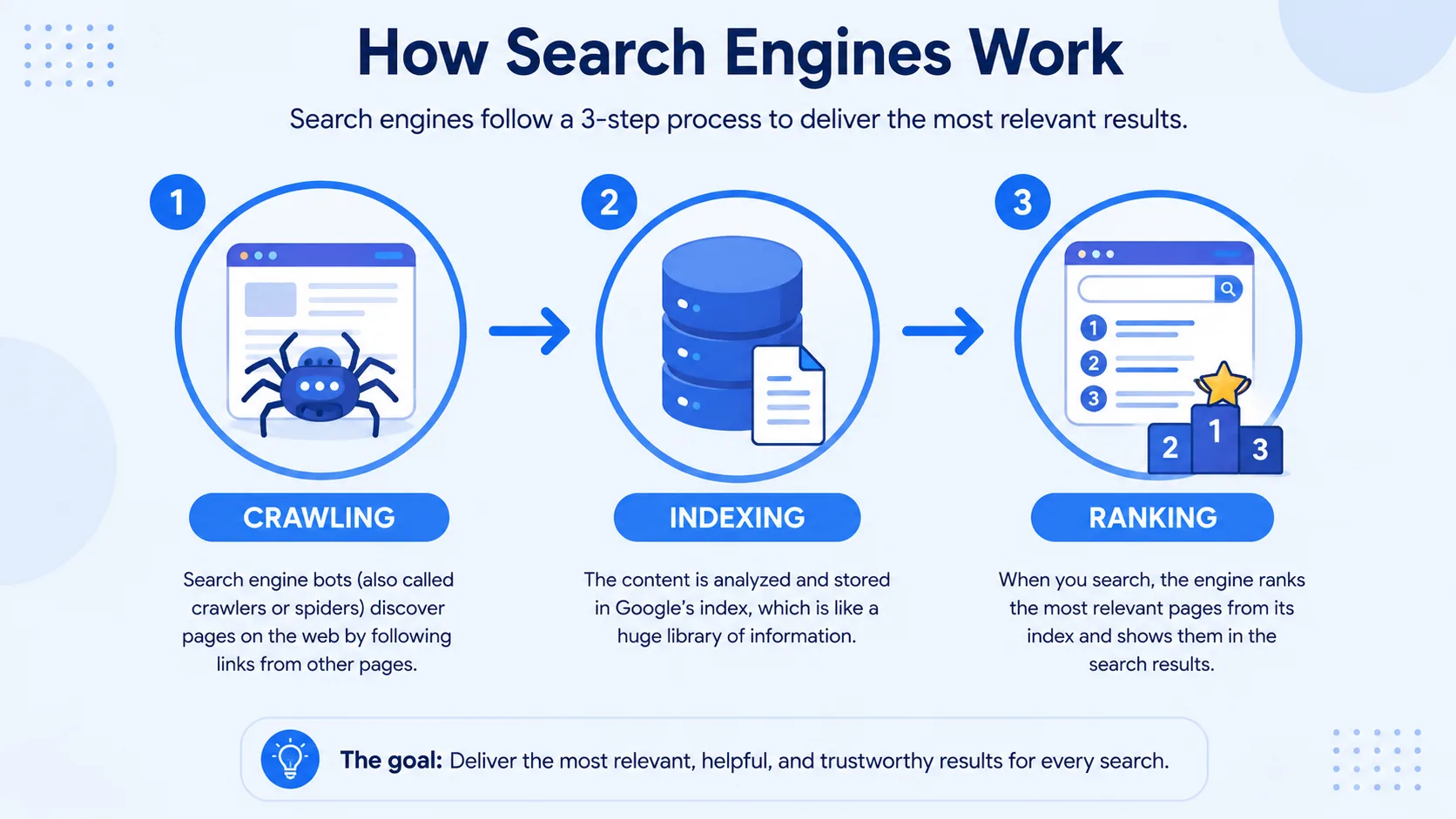
Crawling
Google uses automated bots (Googlebot) that follow links across the web to discover new and updated pages. If a page isn't linked from anywhere and isn't submitted via a sitemap, it may never be crawled.
Indexing
Once crawled, Google analyzes the page's content and stores it in a massive index — think of it as the world's largest library catalog. A page can be crawled but not indexed if it's low quality, duplicate, or blocked by a noindex tag.
Ranking
When someone searches, Google's algorithms sort every relevant indexed page using hundreds of signals — relevance, content quality, backlinks, page experience, and user engagement — to decide the order of results.
Why SEO Matters in 2026
- Free, compounding traffic — unlike ads, a well-ranked page keeps earning visits for years.
- Higher trust — users trust organic results more than ads.
- Better ROI over time — SEO becomes cheaper per visitor than PPC over the long run.
- Business credibility — ranking well signals authority in your niche.
How AI Is Changing SEO
Google AI Overviews
AI Overviews now answer many queries directly at the top of search results, summarizing information from multiple sources. This has increased "zero-click searches" — where the user gets an answer without visiting any website.
Entity SEO and Semantic SEO
Modern search engines understand entities (people, places, concepts) and their relationships, not just keywords. Writing comprehensively about a topic signals topical depth better than repeating one exact-match keyword.
Topical Authority
Sites that publish comprehensive, interlinked content across a subject area (a "topic cluster") tend to outrank sites with isolated, shallow articles — even if the isolated article targets the exact keyword.
Helpful Content System and EEAT
Google's Helpful Content System rewards content written primarily for people, not search engines. It works alongside EEAT — Experience, Expertise, Authoritativeness, Trustworthiness — which Google's quality raters use to judge content.
- Experience — has the author actually used the product/done the thing they're writing about?
- Expertise — does the content demonstrate real subject knowledge?
- Authoritativeness — is the site/author recognized as a credible source?
- Trustworthiness — is the site secure, transparent, and accurate?
Types of SEO
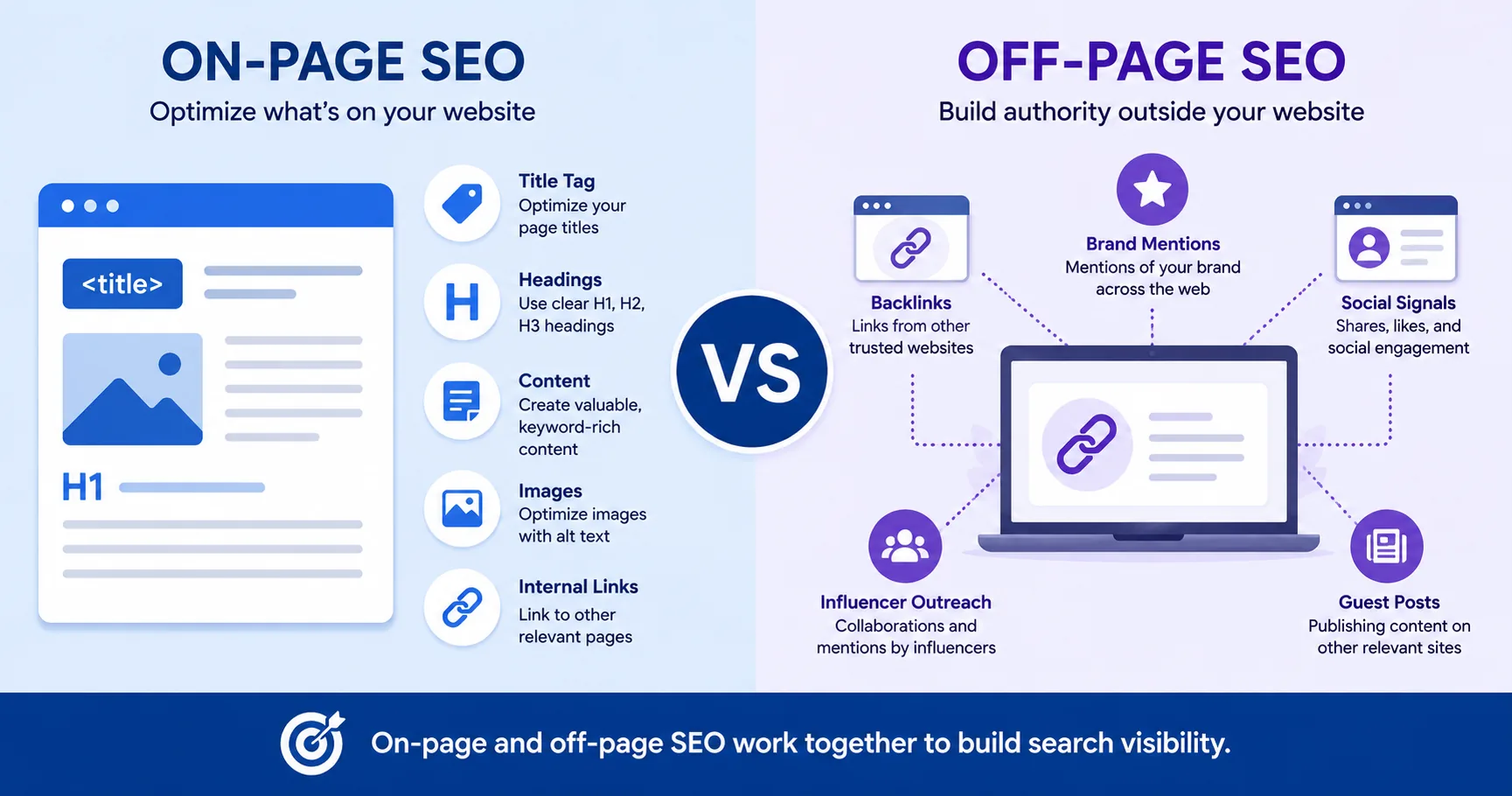
On-Page SEO
Optimizing elements within your own page — titles, headings, content, internal links, and images — to make it relevant and crawlable.
Off-Page SEO
Building authority through external signals — backlinks, brand mentions, digital PR, and social proof — that happen outside your own website.
Technical SEO
Ensuring your site is crawlable, indexable, fast, secure, and structured correctly so search engines can access and understand it without friction.
Local, International & Mobile SEO
Local SEO targets location-based searches through Google Business Profile and citations. International SEO uses hreflang tags and localized content to rank across countries. Mobile SEO matters because Google uses mobile-first indexing — your mobile site's speed and usability directly determine rankings, even for desktop searches.
Detailed On-Page SEO Guide
Direct answer: On-page SEO means optimizing individual page elements — title tags, headings, URLs, content, internal links, and images — so both users and search engines clearly understand what the page is about.
| Element | Best Practice |
|---|---|
| Title Tag | Under 60 characters, primary keyword near the front |
| Meta Description | 150-160 characters, includes keyword + a reason to click |
| H1 | One per page, includes the primary keyword naturally |
| URL | Short, descriptive, keyword-included |
| Internal Links | Link to related pages using descriptive anchor text |
| Alt Text | Describe the image naturally |
Detailed Technical SEO Checklist
Direct answer: Technical SEO ensures a site can be crawled, indexed, and rendered efficiently — covering sitemaps, robots.txt, canonical tags, HTTPS, structured data, and Core Web Vitals.
- ✅ XML sitemap submitted to Google Search Console
- ✅
robots.txtcorrectly configured - ✅ Canonical tags on duplicate or similar pages
- ✅ Site served entirely over HTTPS
- ✅ 301 redirects for moved pages (avoid redirect chains)
- ✅ Structured data implemented and error-free
- ✅ Core Web Vitals passing (LCP, INP, CLS)
- ✅ Images lazy-loaded below the fold
- ✅ Mobile-friendly, responsive design
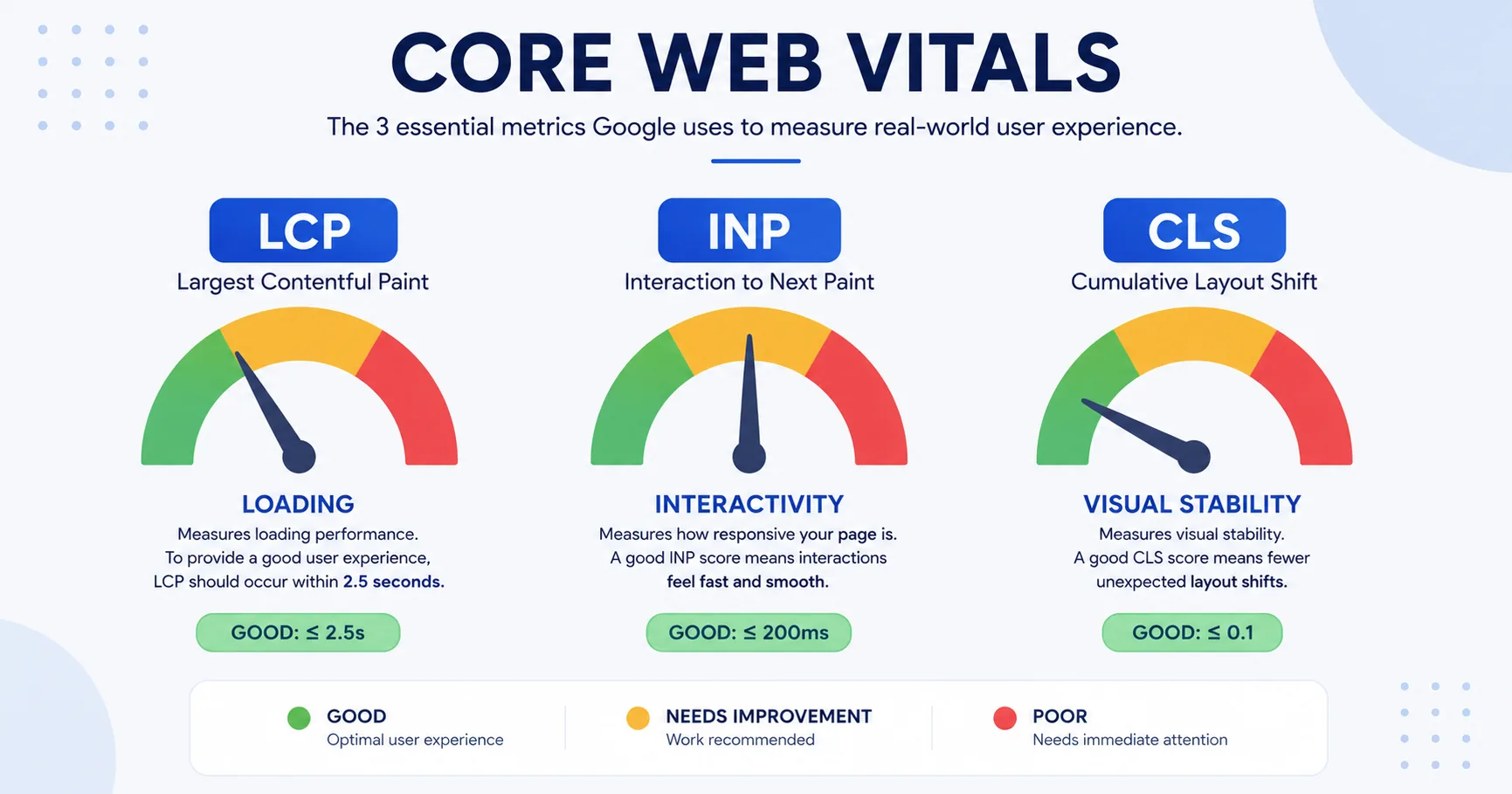
- LCP (Largest Contentful Paint): How fast the main content loads — aim under 2.5 seconds.
- INP (Interaction to Next Paint): How responsive the page feels — aim under 200ms.
- CLS (Cumulative Layout Shift): How much the page visually shifts while loading — aim under 0.1.
Off-Page SEO Explained
Direct answer: Off-page SEO builds a site's authority through external signals — primarily backlinks from other credible websites, along with brand mentions, digital PR, and social proof.
- Backlinks — links from other websites act as "votes of confidence." Quality matters far more than quantity.
- Guest Posting — contributing content to reputable sites in your niche in exchange for a contextual link.
- Digital PR — earning coverage through newsworthy data or stories that journalists want to link to.
- Brand Mentions — even unlinked mentions contribute to Google's understanding of your authority.
🔍 Check Your Content's Keyword Density
Use our free Keyword Density Checker to make sure your on-page SEO is balanced, not stuffed.
Try the Tool →Step-by-Step SEO Guide for Beginners
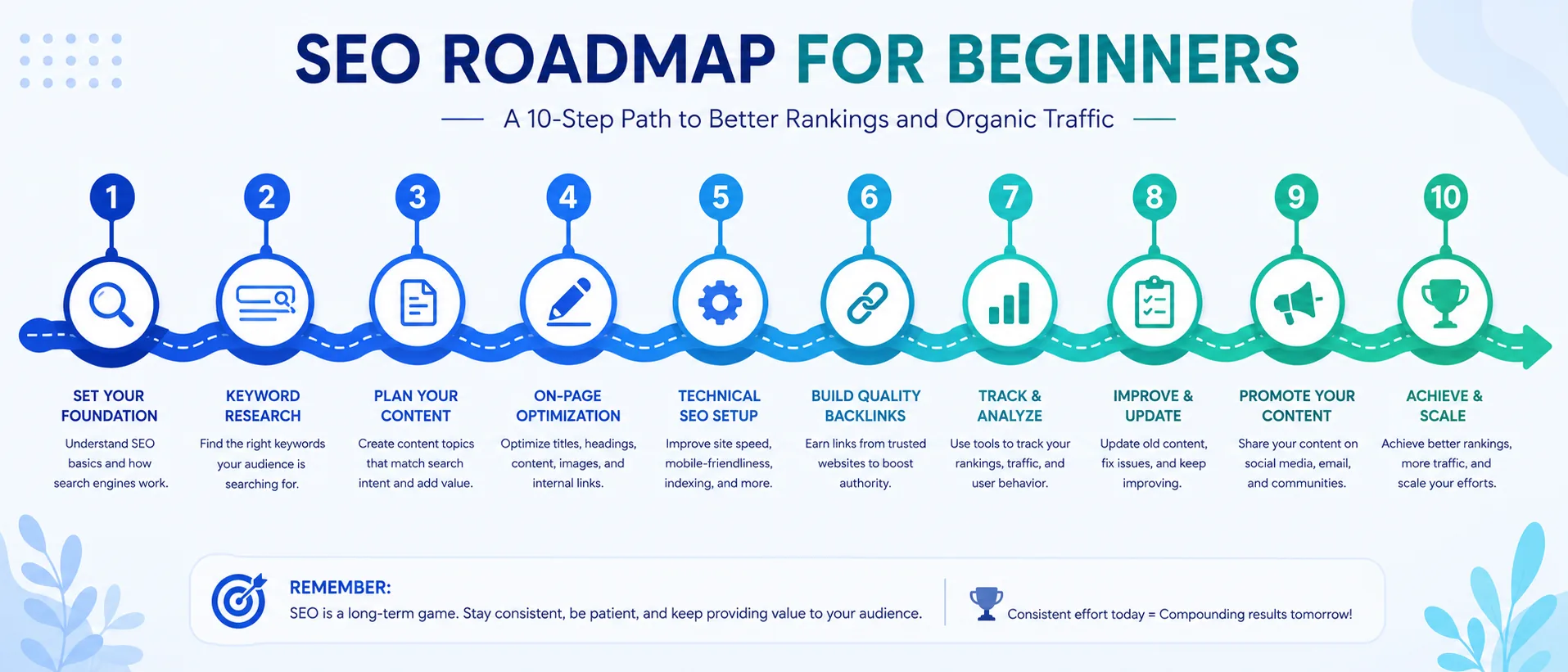
- Website Setup — choose a fast host, install SSL, pick a clean, mobile-friendly theme.
- Keyword Research — identify what your audience searches for and group by intent.
- Content Planning — map out pillar pages and supporting cluster content.
- On-Page Optimization — optimize titles, headings, URLs, and internal links.
- Technical SEO — fix crawlability, indexing, speed, and structured data.
- Link Building — earn backlinks through outreach and digital PR.
- Content Marketing — promote content through email, social, and communities.
- Monitor Rankings — track keyword positions in Google Search Console.
- Improve User Experience — reduce bounce rate through better design and speed.
- Continuous Optimization — refresh old content and expand topic coverage regularly.
Comparison Tables
SEO vs PPC
| Factor | SEO | PPC |
|---|---|---|
| Cost | No cost per click, time-intensive | Pay per click |
| Speed | Weeks to months | Immediate |
| Longevity | Long-term, compounding | Stops when budget stops |
White Hat vs Black Hat SEO
| Factor | White Hat | Black Hat |
|---|---|---|
| Approach | Follows Google guidelines | Violates guidelines |
| Risk | Low, sustainable | High risk of penalty |
| Examples | Quality content, earned links | Link farms, cloaking, stuffing |
Common SEO Mistakes
- Ignoring search intent — match content format to what users expect.
- Keyword stuffing — write naturally with synonyms and related terms.
- Thin content — expand pages to fully answer the topic.
- Duplicate content — use canonical tags or consolidate pages.
- Slow page speed — compress images, use caching and a CDN.
- Missing alt text — describe every meaningful image.
- No internal linking strategy — link related content deliberately.
- Buying spammy backlinks — focus on earned, relevant links.
- Publishing and forgetting — refresh content periodically.
- Not tracking rankings — you can't improve what you don't measure.
Popular SEO Tools
- Google Search Console (free) — monitor indexing, rankings, and technical issues.
- Google Analytics (free) — track traffic, behavior, and conversions.
- Google PageSpeed Insights (free) — measure Core Web Vitals and speed.
- Ahrefs / SEMrush (paid) — keyword research, backlink analysis, competitor tracking.
- Screaming Frog (free/paid) — technical site audits and crawl analysis.
Frequently Asked Questions
What is SEO in simple terms?
SEO is the practice of optimizing a website so search engines can find, understand, and rank it higher for relevant searches, driving free organic traffic.
How long does SEO take to show results?
Most sites start seeing meaningful movement in 3-6 months, with significant results often taking 6-12 months depending on competition.
Is SEO still relevant in 2026 with AI search?
Yes — AI Overviews and chat-based search still pull information from indexed, well-optimized websites, making SEO foundational to AI visibility as well.
What is the most important ranking factor?
There isn't a single factor — content relevance, quality backlinks, technical health, and user experience all work together.
What is EEAT?
EEAT stands for Experience, Expertise, Authoritativeness, and Trustworthiness — the framework Google's quality raters use to assess content quality.
Do backlinks still matter in 2026?
Yes — backlinks remain one of the strongest authority signals, though quality and relevance matter far more than quantity.
What is topical authority?
Topical authority is the trust search engines place in a site that comprehensively covers a subject through interlinked, high-quality content.
Summary
SEO in 2026 isn't about gaming an algorithm — it's about building a website that genuinely deserves to rank: fast, well-structured, trustworthy, and genuinely useful to the people searching for it. Start today — pick one page on your site, run through the on-page checklist above, and fix what's missing.